Judge John Tomasello – Ignores the law & Incarcerates a Man Unlawfully

Standard

AFTER APPEARING BEFORE JOHN TOMASELLO

& REVIEWING CASES THAT HE GOT WRONG

I CAN CONFIRM THAT HE IS A PUBLIC MENACE

Short List of Cases Tomasello has Botched:

1. Houseman v. Dare – Judge Tomasello was overturned after presiding over a dog custody case…

An unmarried man owned a dog and after he dumped his girlfriend she sued for custody

Rather than Dismissing this Case Tomasello presided over a case that ultimately cost the estranged couple over $40,000 in attorney fees… for a dog.

Judge Tomasello allowed Family Court Resources to be deployed for dog welfare rather than addressing the people and children that require the Family Court to resolve conflicts

2. Judge John Tomasello released a Man who solicted sex from a purported Minor Child – because it was a “victimless crime. The man was later convicted.  TOMASELLO WAS WRONG AGAIN… ATTEMPTING CHILD RAPE IS A CRIME IN NJ (SEE ARTICLE HERE)

– The County Prosecutor Took the Unusual Approach of Berating Judge Tomasello in the Local Paper

– You Know a Judge is horrible when the local members of the Bar actually say so publicly … its very unusual!

3. Judge John Tomasello Lied about court orders he issued, and presided over a case where the Defendant was ordered not to appear in court… Judge Tomasello failed to recognize that this was a denial of due-process read about that here.

Judge TRUTH IS NO DEFENSE

TODAY I PRESENT A FOURTH CASE THAT

JUDGE JOHN TOMASELLO BOTCHED SO BADLY

IT WAS OVERTURNED BY THE APPELLATE AND REMANDED TO A

DIFFERENT JUDGE

NOTABLY THE APPELLATE COURT ORDER

INCLUDES JUDGE TOMASELLO’S NAME

DESPITE THE COMMON-PRACTICE OF THE APPELLATE DIVISION

WHEREBY A JUDGE THAT IS OVERTURNED IS NEVER MENTIONED BY NAME

BASICALLY THE APPELLATE COURT WAS

CALLING OUT JUDGE TOMASELLO – BECAUSE THEY WERE OUTRAGED!

READ THE TEXT OF

APPELLATE DECISION

TOMASELLO DEMONSTRATED A FAILURE

TO UNDERSTAND THE LAW


Kangaroo Court Judge


N.J. Superior Court, Appellate Division

A-6101-02T4; Appellate Division; opinion by Fisher, J.A.D.; decided and approved for publication May 23, 2005. Before Judges Fall, Payne and C.S. Fisher. On appeal from the Law Division, Gloucester County, Indictment No. 02-12-0206. [Sat below: Judge Tomasello.] DDS No. 14-2-0297

I. Defendant was charged with first-degree maintaining or operating a controlled dangerous substance (CDS) production facility (marijuana in an amount greater than 10 plants), in violation of N.J.S.A. 2C:35-4; first-degree possession with intent to distribute CDS (marijuana in an amount greater than 50 plants), in violation of N.J.S.A. 2C:35-5(a)(1) and N.J.S.A. 2C:35-5(b)(10)(a); fourth-degree possession of CDS (marijuana in an amount greater than 50 grams), in violation of N.J.S.A. 2C:35-10(a)(3); and third-degree possession of CDS (methamphetamine), in violation of N.J.S.A. 2C:35-10(a)(1).

After the trial judge denied his motion to suppress, defendant entered a plea of guilty to first-degree maintaining or operating a CDS production facility. The trial judge imposed a sentence of 10 years’ imprisonment, one-third of which defendant must serve before becoming eligible for parole. Monetary assessments were also imposed. Pursuant to the plea agreement, the other counts of the indictment were dismissed.

Held: A warrantless thermal-imaging scan of defendant’s home and the warrantless seizure of utility records regarding the amount of electricity consumed in defendant’s home were illegal. As a result, the judgment of conviction is reversed, the denial of the motion to suppress vacated, and the matter is remanded for consideration, after a hearing, of whether defendant consented to the search of his home and, if so, whether the consent search was so impacted by the prior unlawful police conduct as to require the exclusion of the evidence then seized. Also, the trial judge erred by failing to allow testimony about a polygraph test administered to defendant. Lastly, a different judge is to be assigned to conduct all future proceedings in the trial court.

II. In January 2000, Detective William Peacock, lead investigator for the New Jersey State Police’s Marijuana Eradication Unit, obtained information by way of subpoena that defendant had received four packages of indeterminate size and content from a nearby business that sells plant-growth equipment. Why a subpoena was sought to obtain these records was not revealed at the suppression hearing.

Defendant’s mere receipt of this equipment ¿ the precise nature of which has not been revealed ¿ led Detective Peacock to somehow suspect that defendant might be growing marijuana in his home. As a result, Detective Peacock obtained a subpoena to compel a power company to turn over records concerning defendant’s residential use of electricity. The record, however, does not disclose what this information revealed.

On cross-examination, defense counsel sought to explore the content of these electrical records, as well as the manner in which they were obtained. He was permitted only a few questions before the trial judge ruled that this information had no bearing on whether defendant voluntarily consented to a search of his home. Defense counsel, in compliance with the trial judge’s directive, asked no further questions regarding the electrical-usage records.

As a result, the record reflects that when deciding to seek defendant’s consent to a search of his home, Detective Peacock knew only that defendant obtained equipment, only identified as plant-growth equipment, in January 2000; that no unusual amount of heat emanated from defendant’s home when a warrantless thermal scan was conducted in May 2000; and that subpoenaed utility records indicated that defendant’s home used electricity to some unknown extent at some unknown time. Detective Peacock conceded that this information would not support the issuance of a search warrant for defendant’s home, but he felt it appropriate to speak to defendant. Consequently, Detective Peacock determined to engage defendant in a “knock and talk.”

On July 27, 2000, Detective Peacock approached defendant’s residence, in the early morning, with four other law enforcement agents, all in plain clothes and all armed. They entered the curtilage of defendant’s home, without consent. In fact, two officers passed through a gate that had been closed to approach the back door, while the other three officers approached the front door.

Detective Peacock acknowledged that the manner in which the officers approached to engage in this “knock and talk” was compatible with how a search warrant would have been executed, the only difference being that the officers did not have a search warrant and would not have obtained a search warrant, from an impartial judge, if sought.

In addition, contrary to Detective Peacock’s testimony that he simply wanted to talk to defendant, the officer at the front door did not merely request that defendant speak with them but instead demanded that defendant speak to them, saying, “We need to speak to you?”

Detective Peacock testified that all five officers then entered defendant’s home through the front door and that he obtained defendant’s consent, as memorialized on a consent form that defendant executed. Once in the home, according to Detective Peacock, defendant readily divulged that there were 40 marijuana plants growing in the basement. The officers’ subsequent search led to the discovery of more than 100 growing marijuana plants in various parts of defendant’s home, as well as numerous plastic bags containing processed marijuana, and a plastic bag containing methamphetamine.

Defendant disputed Detective Peacock’s version, testifying at the suppression hearing that Detective DeBiase knocked on his front door, said he had a search warrant, and promptly entered the home through the front door with two other officers. The officers inside then let Detective Peacock and the fifth officer in through the back door. According to defendant, no one asked his permission to enter or search the home, but, instead, immediately on entering, an officer handcuffed defendant and told him to sit on a couch in the living room, along with his girlfriend, while the officers searched the home. Only approximately one hour later was defendant asked to sign a form (the aforementioned consent form) that he was not permitted to read. Defendant testified that, when presented to him, the consent form was folded in such a way as to preclude his ability to read its contents, an issue that was explored at the hearing, when it was revealed through the testimony of a retired state police officer that the consent form in question was outdated.

In addition, defendant called a polygrapher to testify. Prior to his being sworn, the trial judge sustained the state’s objection, thus precluding the polygrapher’s testimony regarding the results of his examination of defendant relating to the July 27, 2000, events. Defendant also offered the polygrapher’s testimony of prior consistent statements allegedly made by defendant, which the trial judge initially permitted; however, the trial judge soon thereafter sustained the state’s objection that such testimony was barred by N.J.R.E. 607, a ruling defendant has not challenged on appeal.

The trial judge found Detective Peacock’s version credible. He rejected defendant’s argument that the consent form was folded in a way that, when presented for his signature, barred his examination of its content; found insignificant that the consent form was outdated; found Detective Peacock credibly explained why so many officers were present when the ostensible intent of the visit was to simply “knock and talk”; found reasonable the fact that Detective Peacock passed through a gate, entered defendant’s backyard and approached the back door, because the detective believed that was the door more commonly used by the residents; found that defendant invited the officers into his home because it was raining; found that, on entering the home, Detective Peacock was able to detect the smell of unburnt marijuana; and found that defendant volunteered there were marijuana plants in the basement. From these facts, the trial judge concluded that defendant freely and voluntarily consented to the search of the home, and consequently denied defendant’s motion to suppress.

As observed, the trial judge precluded defense counsel’s inquiries into the legality of the warrantless search of electrical-usage records and did not determine whether such a search required a warrant. Although defendant attempted to assert that the prior searches were unlawful and tainted the consent allegedly given by defendant to a physical search of his home, the trial judge mistakenly failed to consider or decide those issues.

III. Contrary to the trial judge’s ruling, the sufficiency of defendant’s alleged consent to the search of his home may very well have been impacted by any prior illegal searches. Because, contrary to the trial judge’s approach, evidence obtained from a consent search of a home will be excluded if it results either directly or indirectly from illegal police conduct, it must be initially considered whether the officers conducted any prior unlawful searches.

A. Detective Peacock subpoenaed information that defendant purchased plant-growth equipment from a business located in Williamstown. The record does not reveal what this equipment consisted of or why its purchase piqued the detective’s interest, but there is no dispute that this equipment could be used to grow marijuana plants indoors. It is also conceded that it is lawful to purchase or possess such equipment and that it may be used to grow plants that may be lawfully grown. What prompted the police to compel the turnover of this information regarding defendant’s purchase of plant-growth equipment is unknown.

Defendant has not questioned on appeal the lawfulness of the seizure of that evidence.

B. Armed with information that defendant obtained plant-growth equipment, Detective Peacock then conducted, without a warrant, a thermal scan of defendant’s residence in May 2000.

On June 11, 2001, slightly more than one year later, the Supreme Court of the United States held that thermal scanning constitutes a “search” within the meaning of the Fourth Amendment and that such a search of a home may not be conducted in the absence of a warrant. Kyllo v. United States, 121 S.Ct. 2038 (2001). The unlawfulness of such a search, even if not previously announced, should have been understood by law enforcement officials in New Jersey. As Kyllo held, thermal scannings of residences represent “the search of the interior of homes ¿ the prototypical and hence most commonly litigated area of protected privacy.” Id. at 2043.

Kyllo‘s holding, even when defendant’s home was thermally scanned a year earlier, was predictable, because a warrantless thermal scan unreasonably intrudes into and tends to reveal, albeit in a very general way, what occurs within the interior of the home ¿ the “chief evil” the federal and state constitutions were designed to combat. State v. Cassidy, 179 N.J. 150, 159-60 (2004). While such a scan, in and of itself, may reveal nothing more than the greater emanations of heat from particular areas of a structure, the Fourth Amendment’s shield from unreasonable governmental intrusions into the home is not restricted to only those things some would describe as “intimate.”

The Court’s holding in Kyllo, despite the division within the Court itself, was predictable and should not only be applied prospectively.

Although prior to Kyllo a majority of courts had determined that a thermal scan of a structure from a public thoroughfare did not constitute a search, a substantial minority had held to the contrary. Regardless of this imbalance, courts have interpreted the scope of rights granted by Article I, paragraph 7 of the New Jersey Constitution more broadly than courts have interpreted the Fourth Amendment, as more fully discussed later in this opinion.

C. The thermal scan in May 2000 suggested that no unusual or uncommon amount of “waste heat” was escaping from defendant’s home, and, according to the record, Detective Peacock only knew that defendant had purchased lawful plant-growth equipment in January 2000. With this limited and innocuous information, Detective Peacock obtained a subpoena to compel the power company’s records relating to the usage of electricity in defendant’s home as well as other similarly sized homes for comparison purposes. The state acknowledges that the police did not have probable cause to obtain a warrant for the production of these records, but nevertheless argues that such records are fair game and may be searched and seized regardless of the absence of a warrant based on probable cause because citizens have no legitimate expectation of privacy in such records.

Article I, paragraph 7 protects individuals from warrantless searches of a utility’s records regarding the usage of electricity in an individual’s home. The wording of Article I, paragraph 7 is “taken almost verbatim from the Fourth Amendment.” State v. Johnson, 68 N.J. 349, 353 n.2 (1975). Notwithstanding, our courts have recognized that in many instances Article I, paragraph 7 provides greater rights to an accused than the Supreme Court of the United States has found in the Fourth Amendment.

State v. Johnson marks the first step in New Jersey search-and-seizure jurisprudence beyond the basic rights guaranteed by the Fourth Amendment. Ibid. (“[U]ntil now [Article I, paragraph 7] has not been held to impose higher or different standards than those called for by the Fourth Amendment.”) Two years earlier, Schneckloth v. Bustamonte, 93 S.Ct. 2041 (1973), held that knowledge of the right to refuse consent to a search is only one factor in determining the voluntariness of consent. State v. Johnson specifically rejected that approach in interpreting Article I, paragraph 7 and held that, in such circumstances, the state has the burden of proving by clear and positive evidence that consent was voluntarily given, including proof that the accused had knowledge of the right to refuse consent. 68 N.J. at 353-54. Since the Supreme Court’s 1975 departure from Schneckloth, the scope of Article I, paragraph 7 has been found to expand beyond the parameters of the Fourth Amendment in many instances.

Guided by these frequent departures from what State v. Hempele, 120 N.J. 182, 197 (1990), referred to as the Fourth Amendment’s “floor of constitutional protection” ¿ in guaranteeing, through the application of the state constitution, the full realization of our liberties ¿ as a matter of first impression, there is a legitimate expectation of privacy in electrical-usage records maintained by a power company.

Four other courts have specifically decided the issue, three of which have held there is no legitimate expectation of privacy in such records. See Samson v. State, 919 P.2d 171 (Alaska Ct. App. 1996); People v. Dunkin, 888 P.2d 305 (Colo. Ct. App. 1994), cert. denied, sub nom., Smith v. Colorado, 115 S.Ct. 2251 (1995); State v. Kluss, 867 P.2d 247 (Idaho Ct. App. 1993). The decisions of these three courts were based on either the Fourth Amendment or their own state constitutions, and were generated by an approach inconsistent with the scope of Article I, paragraph 7.

Instead, the court aligns its decision with In re Maxfield, 945 P.2d 196 (Wash. 1997), the only case that has found a reasonable expectation of privacy in such records, because Washington’s search and seizure jurisprudence is far more akin to our own.

1. The fact that the records in question were created or are in the possession of some third person, and not the accused, is not the sine qua non for determining the scope of Article I, paragraph 7, as suggested by the state. The state’s position is grounded on United States v. Miller, 96 S.Ct. 1619, 1624 (1976), which held that the Fourth Amendment “does not prohibit the obtaining of information revealed to a third party and conveyed by him to government authorities, even if the information is revealed on the assumption that it will be used only for a limited purpose and the confidence placed in the third party will not be betrayed.”

Miller‘s linking of the legitimate expectation of privacy with third person access to information has not been followed in staking out the boundaries of Article I, paragraph 7. For example, State v. Hunt, 91 N.J. 338, 347 (1982), found no great significance in the fact that the telephone company and some of its employees were aware of the telephone numbers dialed by an individual. Instead, the Court held that the availability of access by others is not alone determinative of a legitimate expectation of privacy. Similarly, State v. Hempele held that garbage “does not lose constitutional protection merely because it is handed over to a collector.” 120 N.J. at 209. State v. McAllister, 366 N.J. Super. 251, 264 (App. Div.), certif. granted, 180 N.J. 151 (2004), found a legitimate expectation of privacy in a bank’s records concerning an accused’s account even though the bank’s employees had access to those records. In each of these examples courts departed from the lesser scope of privacy interests recognized in the Fourth Amendment analysis contained in Miller.

2. The usage of electricity tends to reveal what occurs within the home. Indeed, much of what has been said about the illegitimacy of a warrantless thermal scan (designed to determine whether certain areas of a structure were relatively hot when compared to the rest of the home or neighboring homes) is applicable to the finding of a legitimate expectation of privacy in information maintained by a power company as to the usage of electricity.

Instead of finding that any information about what occurs within the home is subject to protection, the Idaho court in Kluss, quoted with approval by the Colorado court in Dunkin, held that there is no legitimate expectation of privacy in electrical-usage records because those courts believed that such records do not identify any intimate activities of the accused.

This assertion that “waste heat” does not provide intimate details of what occurs within an accused’s home does not comport with Kyllo‘s interpretation of the Fourth Amendment or New Jersey’s own search-and-seizure jurisprudence.

3. This conclusion as to the reasonable expectation of privacy in electrical-usage records is not contrary to what has been held, at least inferentially, in State v. Jones, 179 N.J. 377 (2004), and State v. Sullivan, 169 N.J. 204 (2001). Those decisions dealt with the level of reliability in an informant’s tip of criminal activity. State v. Sullivan determined that a particular tip was reliable as to the name and location of an alleged drug dealer because, among other things, the informant’s tip was corroborated by utility records that identified the owner of the premises in question.

In State v. Jones, 358 N.J. Super. 420, 428 (App. Div. 2003), the Appellate Division alluded to this fact in distinguishing Sullivan, and when the Supreme Court reversed the Appellate Division’s judgment in Jones, it also referred extensively to the circumstances in Sullivan and the fact that the officer in Sullivan had corroborated the informant’s tip by “review[ing] utility records to confirm that the telephone number provided by the informant matched the telephone number of the apartment in the multi-unit building where the controlled buys were purportedly made.” 179 N.J. at 391. Nowhere in any of those opinions may it be ascertained by what authority the police officer was permitted to examine the utility records. Moreover, there is a distinct difference between a warrantless review of utility records to ascertain the name of an occupant of property, on the one hand, and a review of records relating to the usage of power, on the other.

4. There is a legitimate expectation of privacy in electrical-usage records maintained by a power company that precludes the intrusion of law enforcement in the absence of a warrant. Ultimately, there is no philosophical distinction to be drawn between the purpose behind excluding evidence obtained from a warrantless thermal scan of a residence and excluding evidence derived from a warrantless search of a utility’s records as to electrical usage in an accused’s home.

Such a determination may, at times, be affected by policy reasons. For example, in Hunt, the Court noted that “New Jersey has had an established policy of providing the utmost protection for telephonic communications,” and referred to the Legislature’s criminalization of wiretapping as early as 1930 in a statute since superseded by the Wiretapping and Electronic Surveillance Control Act, N.J.S.A. 2A:156A-1 to -34. See 91 N.J. at 345. Neither party has provided any guidance as to the legislatively recognized existence, or lack of existence, of an expectation of privacy in electrical-usage records. Indeed, the Open Public Records Act, N.J.S.A. 47:1A-1 to -13, merely begs the question by stating that “a public agency [such as a public utility] has a responsibility and an obligation to safeguard from public access a citizen’s personal information with which it has been entrusted when disclosure thereof would violate the citizen’s reasonable expectation of privacy.” N.J.S.A. 47:1A-1.

For the reasons indicated, a search warrant is required for utility records that reveal the amount of electricity used in an individual’s home. Because Detective Peacock obtained such records by way of a subpoena, and not by way of a warrant issued by an impartial judge, this search was unlawful.

IV. Having determined that the police had previously engaged in unlawful searches during their investigation of defendant, the Court remands for further proceedings regarding defendant’s motion to suppress in order that there may be consideration of the impact of these prior constitutional violations on the state’s contentions that defendant consented to the search of his home on July 27, 2000, and that the results of that search are admissible.

As is apparent, the proceedings on remand must not be limited solely to a determination as to the taint of the prior unlawful searches on the consent that the trial judge found was given. Instead, it must again be considered whether consent was given ¿ and given voluntarily ¿ because at the prior hearing the trial judge did not permit the full (or any) use of the prior unlawful searches nor did he consider how that unlawful conduct called into question the credibility of the state’s version of the July 27, 2000, events.

On remand, the judge should consider but not necessarily be limited to weighing the impact of the prior unlawful police conduct (1) on the credibility of the police version of the alleged consent search, (2) on the legitimacy of the manner in which the police sought consent, and (3) on whether the police had a reasonable suspicion that would justify seeking defendant’s consent to a search of his home. In addition, even if it is found after such an examination that defendant freely and voluntarily consented to the search of his home, the judge must also consider whether that consent was tainted by the prior unlawful conduct.

In weighing the circumstances eventually revealed at the future suppression hearing, the judge must first determine how the prior unlawful conduct impacts on the credibility of the police version of what occurred on July 27, 2000. In determining whether consent was requested or given, the judge should weigh whether the prior unlawful conduct might suggest that consent was not lawfully obtained. The judge is entitled to doubt the likelihood that the officers acted in a constitutionally permissible manner on July 27, 2000, when they did not so act on prior occasions. And while a strict application of N.J.R.E. 404(b) (stating that evidence of prior wrongs, although admissible for other purposes, “is not admissible to prove the disposition of a person in order to show that he acted in conformity therewith”) might suggest the preclusion of the officers’ prior wrongful acts, it is well-established that the rules of evidence do not apply at suppression hearings. N.J.R.E. 104(a).

Therefore, evidence of prior unlawful searches is relevant not only to a consideration of whether the search of defendant’s home constitutes the “fruit of the poisonous tree,” as more fully discussed later in this opinion, but also in analyzing whether the unlawfulness of the search in question is suggested by the unlawfulness of prior searches.

Second, the trial judge mistakenly rejected the significance of the fact that the officers, by passing through a gate and entering defendant’s backyard, had entered the curtilage of defendant’s home without consent, without a warrant and without probable cause. Although the federal and state constitutional prohibitions on unreasonable searches and seizures do not “bar all police observation” and have “never been extended to require law enforcement officers to shield their eyes when passing by a home,” and, for example, have not been found to bar a warrantless aerial observation of a fenced-in backyard, California v. Ciraolo, 106 S.Ct. 1809, 1812 (1986), there are limits to the extent to which the police may make a warrantless entry into the curtilage of an individual’s home. On remand, the judge may consider whether the warrantless intrusion by Detective Peacock and another officer into the gated backyard of defendant’s property transgressed defendant’s expectation of privacy and how, if unlawful, it may impact on the credibility of the state’s contention that the police acted lawfully when seeking defendant’s consent to a search of his home. By the same token, the judge should permit and consider any other evidence the state may seek to offer to justify the manner in which they approached defendant’s home.

Third, the judge should consider whether the police had sufficient information from which to seek defendant’s consent to the search of his home. To seek consent for such a search, the officers’ existing, lawfully obtained information must have been sufficient to generate a reasonable and articulable suspicion that criminal activity was occurring within.

Lastly, even if the judge determines on remand that defendant freely and voluntarily gave his consent to a search of his home, and even if the judge determines on remand that the police had a reasonable and articulable suspicion to seek defendant’s consent to that search notwithstanding the exclusion of the unlawfully obtained evidence, the judge must determine whether that consent search was tainted by the prior unlawful police conduct. The trial judge viewed the law enforcement activities that preceded the alleged consent search to be irrelevant. This was a mistake.

Whether a consent search cleanses the taint of prior illegal searches and seizures is not always clear. However, there is no doubt that a mere finding that the subsequent consent was free and voluntary is not alone sufficient to avoid the impact of the “fruit of the poisonous tree” doctrine. If we were to accept the trial judge’s view that defendant’s purported consent rendered irrelevant the prior unlawful police conduct, we would undermine the purposes of that doctrine. Such a holding would have a tendency to allow the police to conduct illegal searches and seizures with impunity, knowing that consent might later be readily forthcoming when the accused is confronted by police, armed with knowledge illegally obtained, and thereby absolve the police of the impact of their prior unlawful conduct. Such an approach, if adopted, would eviscerate the exclusionary rule’s deterrent effect.

V. In his supplemental brief, defendant argues that the trial judge erred by barring testimony about the results of a polygraph examination performed on defendant, including, supposedly, the expert’s opinion that defendant’s contention that he did not consent to the search was truthful.

The trial judge summarily refused to permit this testimony because he considered it irrelevant, and ultimately inadmissible. The judge also ruled that this testimony encroached on the ultimate issue to be decided, and that it constituted a waste of time. These four reasons given by the trial judge were insufficient to justify the exclusion of this testimony.

A. The judge was required, in part, to determine whether defendant consented to the search of his home, which turned on the “swearing contest” between Detective Peacock and defendant about what actually occurred on July 27, 2000. Since the polygraph testimony related, no matter how imperfectly, to the truthfulness of defendant’s version, it comported with N.J.R.E. 401’s broad standard of what is relevant.

B. The trial judge also summarily excluded the polygraph testimony because he believed it was inadmissible. This was also erroneous. State v. McDavitt, 62 N.J. 36, 46 (1972), held that polygraph testing had developed to such a point of reliability that the results could be admitted into evidence in a criminal matter if both the state and defendant so stipulated.

Polygraph testing is designed to demonstrate that the person tested was or was not truthful in answering certain questions based on measured changes in blood pressure, pulse, thoracic and abdominal respiration, and galvanic skin response. The polygraph as a device for detecting truthfulness is based on the assumption that changes in these physical conditions indicate an increase in stress consistent with deception. In a nonjury setting the admission of this type of evidence, when a proper foundation has been laid, is not limited by McDavitt‘s stipulation requirement.

In weighing the admissibility of such evidence in the present circumstances, the judicial system recognizes that cases are already adjudicated through the use of “lie detectors.” If the court was to allow a fact finder to detect whether a witness is lying or telling the truth based on observations of demeanor ¿ thus permitting the fact finder to consider among many other things whether, while testifying, the witness breathed heavily, perspired, spoke haltingly, avoided eye contact, gestured excessively, or gave off the unpleasant “odor of mendacity” (Williams, “Cat On A Hot Tin Roof,” Act III (1955)), then it should follow that measurable physiological occurrences during the answering of questions, such as changes in pulse rate, blood pressure, respiration or perspiration, may be probative of a witness’s credibility.

Here, while the parties did not enter into such a stipulation, the circumstances are distinguishable from McDavitt, chiefly because McDavitt considered the use of polygraph evidence at a trial, before a jury, to determine defendant’s guilt. Thus, in weighing the applicability of this stipulation


CITIZENS ARE THE MOST POWERFUL “LEGAL PERSON” IN COURT

Standard

===========================================

NOTICE:

THE FIRST 1-2 ARTICLES ON THIS SITE ARE

PERMANENT STICKY POSTS SCROLL DOWN OR VISIT ARCHIVES

TO VIEW NEW ARTICLES

===========================================

King Crown


A DIFFERENT THEORY ON:

HOW TO DECLARE CITIZEN’S SOVEREIGN AUTHORITY

AS A CONSTITUTIONAL CREATION: A CITIZEN


Some of our readers have asked us about “Sovereign Citizen Movements” and they have asked what our opinon is (as if it matters in court).

THE BAD NEWS FOR SO CALLED SOVEREIGN CITIZENS:

Without taking a stand one way or the other on the legal theories offered by sovereign citizen movements such as Posse Comitatus etc. Our position is simple. “Sovereign Citizens” rarely win in court and the complex legal arguments are rarely helpful to anyones cause (whether they are right or wrong).


THE GOOD NEWS:

We don’t believe that anyone needs to give up their drivers license or pitch a conspiracy theory to a Judge to claim Sovereignty.  We believe that CITIZENS ARE INHERENTLY “THE SOVEREIGN” with or without their Drivers License or Social Security Card.

The Sovereignty  of citizen / the people is recognized by the Constitution of the United States of America, visa vi the 10th Amendment of the Bill of Rights, which states (in toto):

The powers not delegated to the United States by the Constitution, nor prohibited by it to the States, are reserved to the States respectively, or to the people”

(Clearly the Constitution recognized both the sovereignty of the state and the people by expressly establishing that both have inherent power / authority independent of the Federal Sovereign, and independently from each other!)


THE MOST POWERFUL LEGAL PERSON IN COURT:


  • A pro se / Self Represented Litigant Appears as at least 5 “legal persons”:

1. A citizen (A Constitutional Creation) who claims ownership of the authority of; The Court, The Executive Branch, The Legislatrure (as the primary sovereign Authority in America)

2. As Attorney-in-Fact (A  Legal  Person) with Litigation Privileges Equal to an Attorney at Law)

3. A Witness-of-Fact (A Legal Person) with the authority to speak to the facts of the matter thereof, and put them before the court (Neither Lawyer or Judge may do this)

4. A Real-Party-of-Interest (A Legal Person)  with rights to advocate for their individual legal interests in the matter before the court, without being either representing the Defendant or Plaintiff in the matter before the court.

5. A Natural Man in the Flesh (A Sovereign Creation) empowered with INALIENABLE RIGHTS that pre-date the Magna Carta (With the Power to reform Government and arrest any criminal)

CONVERSELY

JUDGES & ATTORNEYS LACK SIMILAR AUTHORITY & RIGHTS:


  • A Judge appears: ONLY AS as  the highest ranking an officer of the Court at trial & Neutral Fact Finder.

    • A Judge enters the court in this single capacity (not as citizen, or sovereign, but only as agent to the sovereign)
    • A Judge: CAN NOT ACT AS WITNESS TO THE FACTS OF THE MATTER BEFORE THE COURT, (except with regard to facts of the matter that occurred during the court proceedings)  (Citation: N.J.R.E. 605, F.R.E. 605)
    • A Judge Can Not Over-rule a Citizen Jury at trial.
    • A Judge Can Demand a Verdict From a Jury BUT A JURY CAN NULLIFY A CASE AND REFUSE TO PROVIDE A VERDICT!, because they are sovereign citizens… IN FACT THE JURY IS THE “4TH BRANCH OF GOVERNMENT”, per  U.S. Supreme Court  Justice Scalia

(Citation Williams v. United States, 1996)


  • An Attorney-at-law appears: ONLY as an officer of the Court at trial on behalf of a client.

    • An Attorney HAS NO RIGHTS, JUST PRIVILEGES, which can be taken at away at the whim of the court or B.A.R. Association
    • An Attorney can only advocate for their privileged title / position (if taken away) by invoking their rights as a citizen – but not while acting as a retained lawyer.


…AS SUCH:

NO PARTY IN COURT HAS MORE AUTHORITY & RIGHTS THAN

A PRO SE CITIZEN


HERE IS OUR THEORY ON CITIZEN SOVEREIGNTY

&

THE FACT THAT CITIZENS ARE MORE POWERFUL THAN JUDGES


YOUR HONOR – TAKE JUDICIAL NOTICE OF THIS THESE FACTS:

The American Form of Government (and our legal system’s) primary difference with the British Common law is that we rejected the concept of divine sovereignty of royals, and instead recognized the sovereignty of natural men and their rights to self-govern with sovereign power.

AS SUCH:

WE hereby assert that WE (THE CITIZENS) have the sovereign authority to now hold you (JUDGES) accountable for these transgressions in open court today. 

WE make this assertion with out making any claim to the disputed or conspiratorial theories espoused by so-called “Sovereign Citizens”.

Importantly WE take no stance on any of the purported theories of such Sovereign Citizens, nor do WE attempt to claim any allegiance to any groups that advocate for such theories (e.g. Posse Comitatus, or their ilk)

Unlike the Posse Comitatus and their ilk:


I / WE make claim to my citizenship & sovereignty BY ASSERTING MY CITIZENSHIP RATHER THAN DISAVOWING IT AS SO-CALLED “SOVEREIGN CITIZENS” PURPORT TO DO.

I / WE  do not believe that consenting to hold a drivers license or Social Security Card interferes with OUR sovereign authority as a citizen.


… INSTEAD WE MAKE THE FOLLOWING CLAIM:


I / WE MAKE OUR CLAIM TO SOVEREIGN AUTHORITY BECAUSE I / WE ARE A CONSTITUTIONAL CREATION.

I / WE ARE CITIZEN(S) OF THE UNITED STATES OF AMERICA AND I / WE  ARE A CITIZEN OF NEW JERSEY.


AS SUCH:

I / WE ARE MEMBERS OF THE MOST POWERFUL BRANCH OF GOVERNMENT, AS CITIZENS.

AS SUCH:

I / WE HAVE AN OWNERSHIP STAKE IN ALL FOUR BRANCHES OF GOVERNMENT

(Executive, Legislative, Judicial, and Jury (Grand Jury & Petite Jury) )


To this point I /WE demand you take judicial notice of the following widely known facts:


1) The system of Self-Government embodied by the Federal and State Constitutions recognize the power of citizens to form or reform the government however we so choose, because the power of the sovereign is recognized to originate from the citizen class.


2) Citizens are the alpha-omega of sovereignty in the American Legal System:

The Government is simply a result of our sovereignty, as such it is indisputably the “BETA” to the citizens “ALPHA” position within the legal construct of Government.

Citations: Declaration of Indpendence 1976 (in toto / in whole), Constitution of the United States of America, original Jurisdiction 1787 (in toto), State Constitution of New Jersey 1947 (in toto)


3) Citizens own and control the FOURTH BRANCH OF GOVERNMENT (THE GRAND JURY). This was confirmed by the United States Supreme Court in the majority Opinion written by Justice Scalia in United States v. Williams (90-1972), 504 U.S. 36 (1992).

Citation: http://www.law.cornell.edu/supct/html/90-1972.ZS.html


4) The American Form of Government (and our legal system’s) primary difference with the British Common law is that we rejected the concept of divine sovereignty of royals, and instead recognized the sovereignty of natural men and their rights to self-govern with sovereign power.


5) Citizens are among the only Constitutional persons who can completely disregard the doctrine of separation of powers between each of the branches of government, because we own all four branches.

Citizens own the authority’s granted to the Governor

Citizens own the authority granted to the legislature

Citizens own the authority granted to the court

Citizens are the authority of the Jury (Both Grand and Petite)

Citizens of New Jersey are the only persons constitutionally empowered to both arrest and prosecute the a criminal matter, which the same (person/)citizen witnessed

Citizens are the only constitutional creation who can conspire to reform all four branches of government by the sheer power of their will.

While the individual branches of  Government lack the sole authority to control AND fund a well armed Militia… We the citizens can fund and control a Well Armed Militia, in fact in some rare cases – WE ARE the Well Armed Militia.


WHAT WE DO WHEN A JUDGE ACTS UNLAWFULLY TOWARD

“THE SOVEREIGN”

Boston Tea Party

WE DECLARE A MISTRIAL

&

WE DECLARE OUR SOVEREIGN AUTHORITY TO DO SO

======================================================
YOUR HONOR, GIVEN THE ABOVE:

IN CASE YOU MISSED THE NEWS A FEW YEARS AGO:

…. A FEW OF US CITIZENS THREW SOME TEA IN THE OCEAN AND….
======================================================


YOUR HONOR, YOU HAVE INSULTED, DEMEANED, AND DIMINISHED THE INTEGRITY OF THIS COURT.

AS YOUR SOVEREIGN I WILL NOT TOLERATE IT A SECOND LONGER.


LIKE A CHILD WHO DISOBEYS THEIR PARENT YOU HAVE DISAPPOINTED ME AND WILL NOW BE HELD ACCOUNTABLE TO YOUR PARENT.


YOUR HONOR, YOUR BIGGEST MISTAKE WITH REGARD TO MY LEGAL AFFAIRS AND YOUR BIGGEST SIN HAS BEEN YOUR ARROGANCE.

TODAY I WILL ASSURE YOU I  WILL REMOVE THAT CONCERN FROM THIS COURT FOREVER.


AS YOUR SOVEREIGN I DEMAND YOU STEP DOWN FROM THE BENCH WITH REGARD TO THIS MATTER.

YOU ARE NOT CLOAKED IN ANY JUDICIAL IMMUNITY GIVEN THE TRANSGRESSIONS DESCRIBED ABOVE (YOUR COURT ORDERS), YOU ARE NO LONGER NEUTRAL, AND YOU ARE NO LONGER THE JUDGE OF THE FACTS THEREOF IN THIS MATTER…

BEGONE I SAY…

BEGONE NOW OR:

I WILL PLACE YOU UNDER ARREST.

I WILL DEMAND YOUR TREASON BE FULLY PROSECUTED BY THE STATE, AND

BE ASSURED THAT ANY MISDEMEANOR CRIMES MAY BE PROSECUTED BY MYSELF AS A PRIVATE PROSECUTOR PURSUANT THE NEW JERSEY CONSTITUTION AND:

MY COMMON LAW RIGHT TO HAVE YOU CRIMINALLY SANCTIONED AT TRIAL!

King Crown


I remind the court that I hold more powers and privileges than

any other legal person in the court today.


Citizens appear in court as:

5 DISTINCT LEGAL “PERSONS” SIMULTANEOUSLY!

1) I am a “Citizen” of New Jersey (“a legal person”) empowered with the right to:

a) Arrest criminals who commit crimes in my presence (even a Judge can not do this while on the bench)

b) Prosecute crimes privately per the New Jersey Constitution of 1947 (even a Judge while on the bench)

c) I have the right to conspire to reform any of the three representative branches of Government without regard to the Separation of Powers Doctrine

2) I am an pro se “Attorney-in-Fact” (a “Legal Person”) for the cause before the court with the right to

a) File my pleadings without adhering to the court rules (neither a judge or a member of the bar can do this)

b) Access the court in whatever legal manner I desire to with regard to resolving my legal matters

3) I am a “Witness-of-Fact” (a “Legal Person”)

a) I have the power to testify to facts-of-the-matter-thereof, unlike an attorney or Judge

b) A judge can not do this according to N.J.R.E. 605 / F.R.E. 605  because: “a judge may not serve as witness and judge in the same matter”.

c) A lawyer can not testify to facts of the matter if those facts are also within the Knowledge of their client… only a pro se, citizen can testify in this manner.


4)I am a “Real Party” (a “Legal Person”) with rights greater than a witness-of-fact or citizen

1) A Real Party of Interest is a party with a stake or claim to the underlying legal proceedings

2) A Real Party of Interest has the right to be notified of court proceedings affecting their interests and they have the right due-process.

3) All court orders which result without providing opportunity for a real party of interest to be heard are voidable, even if they were issued years ago.


5) I am a “Natural Man” (a “Sovereign Creation”)

a) I have INALIENABLE RIGHTS which pre-date the Declaration of Indpendence, the Magna Carta, and the corpus of common-law.

b) American Jurisprudence and law is founded on the idea that every man has inalienable rights such as freedom and pursuit of liberty

CONCLUSION:

Gavel Broken

WE BELIEVE THAT WHEN WE FILE WITH THE COURT WE SIMPLY NEED TO INVOKE THE RIGHTS OF ALL 5 LEGAL PERSONS WITHIN THE MOTION PAPERS TO ASSERT THE RIGHTS DESCRIBED ABOVE.


IN OTHERWORDS:

Expressly include in our motions:

Plaintiff/Defendant

appearing as the following legal persons:

pro se, attorney-in-fact;

Citizen of New Jersey & United States of America;

witness-in-fact;

real party of interest; and

Natural Man

(herewith invoking legal all rights and  privileges applicable to the aforementioned legal persons)


ITS A CUMBERSOME SOLUTION BUT, ITS A RESULT OF HAVING MORE LEGAL TITLES THAN ANY OTHER PARTY IN COURT.


OUR MOTIONS WOULD THEN INCLUDE:

A SHORT LEGAL ARGUMENT

SUPPORTING OUR AUTHORITY AS THE AFOREMENTIONED LEGAL

PERSONS AND OUR SOVEREIGNTY PURSUANT THE 10TH AMENDMENT.


The End Writing

STATE OF NEW JERSEY COURTS – IGNORE SUPREME COURT RULINGS – UNLAWFULLY INTERFERE IN PARENTING TIME

Standard

Crony King


BELOW IS SOME INFORMATION SUBMITTED TO THE WEBSITE BY A PERSON IN NEW JERSEY THAT COMPILED RESEARCH FOR THEIR OWN MOTION TO THE COURT.

ITS A FASCINATING SUMMARY OF SUPREME COURT DECISIONS THAT PROHIBIT NEW JERSEY COURTS FROM INTERFERING IN PARENTING TIME DECISIONS OF “FIT PARENTS”.


IT HAS BEEN SUGGESTED TO  THIS WEBSITE THAT:

1) Any Court that issues orders inviolate of these Supreme Court Decisions is violating parents Constitutionally Protected “Due Process Rights” and orders issued contrary to these decisions are legally null and void.

2) In practice I suspect the New Jersey Courts and the Bar Association will Continue to Ignore these U.S. Supreme Court Decisions because these decisions get in the way of bilking innocent families out of hundreds of thousands of dollars individually and billions of dollars collectively


U.S. SUPREME COURT DECISIONS

PROHIBITING “THE STATE” FROM

INTERFERING IN PARENTAL DECISIONS


Court Order Judge

THE FOLLOWING TEXT IS CIRCULATING AMONG FAMILY RIGHTS ADVOCATES TODAY

WE HAVE REPUBLISHED IT HERE TO INCREASE THE DISTRIBUTION OF THIS FREE INFORMATION:


THE FOLLOWING CITATIONS COME ALSO FROM: HERE


    1. In Parham v. J.R. et al 442 U.S. 584 (1979) in toto, inclusive of cited cases, and specifically with regard to its findings that:

      • The Supreme Court declared the ‘best interest of the child’ resides in the fit parent – not in the state: “Our constitutional system long ago rejected any notion that a child is a “the mere creature of the State” and, on the contrary, asserted that parents generally “have the right, coupled with the high duty, to recognize and prepare [their children] for additional obligations.”
    2. Santosky v. Kramer 455 U.S. 745 (1982) in toto and specifically with regard to its legal findings that:

      • To deny a parental right requires constitutional due process that proves he’s either unfit or a clear danger to his children – proven with ‘clear and convincing’ evidence. As such, Santosky v. Kramer 455 U.S. 745 (1982) emphasized to restrict a fundamental right of a parent to any extent, requires a showing of clear and convincing evidence that serious harm will come to the child.
    3. Meyer v. Nebraska, 262 U.S. 390, 399, 401 (1923) in toto and with regard to the legal fact that the Supreme Court established the following:

      • ‘liberty’ protected by the Due Process Clause includes the right of parents to “establish a home and bring up children” and “to control the education of their own.”
    1. Washington v.Glucksberg, 521 U.S. 702, 719 (1997) in toto, including citations, and with regard to:

      • The right to Due Process includes a substantive component to the process that “provides heightened protection against government interference with certain fundamental rights and liberty interests.” Id., at 720; see also Reno v. Flores, 507 U.S. 292, 301302 (1993).


… IF THE CITIZENS CAN NOT GET THE COURT TO ABIDE THE ABOVE LAWS, THEN:

WE SHOULD PREPARE TO DO THE FOLLOWING:

Serfs hoe

Note: We think it is worth filing / citing these cases with our motions now that we have reviewed them.  Why Not?  Can’t make things any worse with regard to our cases. What readers of this cite do with this information is an individual decisions, which we withhold any advisement concerning. This website is does not provide this information as legal advise nor do we have any certified legal expertise express/implied or otherwise.

JUDGES LYING TO JUDGES … OH MY!!! – In Letter Form

Standard

deviljudge

WHAT HAPPENS WHEN ONE JUDGE LIES TO ANOTHER JUDGE

BELOW I SUBMIT THE ANSWER

&

THE UGLY TRUTH

(Spoiler Alert: Judicial Conduct Committee and Self Regulation of the Courts is a Fraud)


Court Order Judge

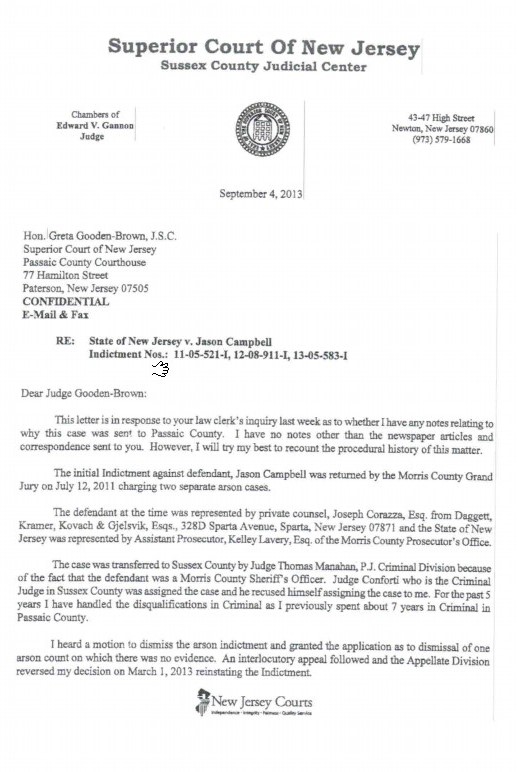
NOTES ABOUT JUDGE GANNON’S LETTER & HIS DISGUST:

  • His Letter Recounts a Scandalous Experience “Expletives Deleted” he says!
  • The Original Letter was likely drenched in tears and includes quotes from Shakespeare and Macbeth (Morbid)
  • The Letter would be hilarious if only it was fiction!
  • At the bottom of this Article (Click Here) is Included a “Sloppy” Legal Brief from a litigant who had a similar experience in another County


LETTER FROM JUDGE GANON EXPRESSING:

His disgust with the New Jersey Judiciary

&

Its Lying Ways:


Judge Gannon p1 2013-09-03 Judge Gannon p2 2013-09-03 Judge Gannon p3 2013-09-03


… WHY SHOULD WE TRUST THESE JUDGES AGAIN ???

 Fingers Crossed Oath

OH YEAH BECASE THEY SWORE AN OATH….

… AND THEYTOLD US TO TRUST THEM


WAIT …. THERE IS MORE:


BURLINGTON COUNTY & MERCER COUNTY JUDGES

PLAY SAME DIRTY GAME


Scales Flaiming

TRANSFER ORDERS WITHOUT ANY LEGAL JUSTIFICATION PROVIDED:

ASSIGNMENT JUDGE C. JACOBSON (MERCER COUNTY) TRANSFERRED THE CASES WITH THESE VAGUE COURT ORDERS (NO FACT FINDING NO RECUSALS)


  1. 2013-11-22 – ORDER – CASE 13-2502 – Jacobson – Jimenez Recusal

  2. 2014-01-17 ORDER TRANSFER CIVIL DOCKETS


THE DEFENDANT FILED A BRIEF TO OBJECT TO THE TRANSFER ORDERS SEE THAT “SLOPPY” LEGAL BRIEF BELOW


SEE THE BRIEF HERE:

SEPTEMBER 2014 LEGAL BRIEF:

CITING PATTERN OF MISCONDUCT SIMILAR TO WHAT JUDGE GANNON EXPERIENCED … BUT WORSE!

READ THE BRIEF – SCATHING / OTHER ISSUES RAISED

NOTES

  • Assignment Judge Mary Jacobson, Presiding Judge Catherine Fitzpatrick, Judge Marbrey decided to Transfer Cases without recusing any of the Judges AFTER TRIALS HAD BEGUN… THE COURT ORDER DOES NOT EXPLAIN WHY. THESE CASES WERE TRANSFERRED
  1. FV-11-00887-13 (Bischoff v. Syphrett);
  2. FV-11-00625-13 (Wallace v. Syphrett);
  3. FM-11-00097-11 (Wallace v. Syphrett);
  4. Prosecutor Case #03-2502-13 (State v. Syphrett)
  • After this Pro Se litigant went through hell in Mercer County the Judges became afraid of being accountable for misconduct and


…. SO THE JUDGES IN NJ CONTINUE TO BREAK THE LAW ….


Justice Gagged

AN ANONYMOUS JUDICIAL CONDUCT COMPLAINT WAS FILED

ON BEHALF OF JUDGE GANNON

AND DEREK SYPHRETT ON 9/17/2014

SEE A.C.J.C. COMPLAINT FAX COVERSHEET HERE:

LETTER: ACJC COMPLAINT 9/17/2014 F’OR:

ASSIGNMENT JUDGE THOMAS WEISENBECK &  ASSIGNMENT JUDGE MARY C. JACOBSON


LET’S SEE IF THE A.C.J.C. INVESTIGATES

THIS UNLAWFUL CONDUCT


IF THEY DO NOT INVESTIGATE,

… THEN PREPARE YOURSELF FOR THE CONSEQUENCES

BY DOING THE FOLLOWING:

Serfs hoe

BECAUSE IT WILL MEAN YOU HAVE NO RIGHTS IN NJ COURTS!

Just Like This Guy Found Out When Court Officers Kidnapped Him to Shut Him Up (Click Here For That Story)

ABSOLUTE JUDICIAL IMMUNITY – NOT ABSOLUTE IN NEW JERSEY ANYMORE!

Standard

Gavel Stopper

THE BIG NEWS

3 FEDERAL COURT JUDGES PLAY ROLE OF THE HEROES!!!


Today the New Jersey Law Journal has published a short article describing the amazing decision of the Third Circuit Judges Today.

BE ADVISED THIS IS HUGE NEWS, BECAUSE LAWSUITS AGAINST JUDGES IN FEDERAL COURTS HAVE BEEN DEAD ENDS FOR DECADES

THEY ARE ROUTINELY DISMISSED

YET TODAY WE NOW HAVE A “NEW DEAL” IN NEW JERSEY DUE TO THIS CASE


HERO JUDGES OF THE YEAR:

The Third Circuit panel of:

  • The Very Honorable Judge Michael Chagares,
  • The Very Honorable Judge Joseph Greenaway Jr.,
  • The Very Honorable JudgeThomas Vanaskie

Greatest American Hero

THESE FINE DISTINGUISHED JUDGES STATED THE FOLLOWING

IN THEIR 16 PAGE UNANIMOUS OPINION:


(edits included for style and emphasis (bold, line breaks, etc)

“we must decide whether the Complaint set forth allegations that, taken as true, establish that the application of an exception to the doctrine of absolute judicial immunity is “above thespeculative level [].

Bell Atl. Corp. v. Twombly, 550 U.S. 544, 555 (2007); see also McTernan v. City of York, 577 F.3d 521, 526 (3d Cir. 2009) (We have stated that, indeciding a motion to dismiss, all well pleaded allegations of the complaint must be taken as true and interpreted in the light most favorable to the plaintiffs, and all inferences must be drawn in favor of them.”) (internal quotation marks and alter ations omitted).

For the reasons set forth below,[:]

we agree with the District Court’s determination that[:]

Judge DiLeo is NOT entitled to absolute judicial immunity.

The well – established doctrine of absolute judicial immunity shields a judicial officer, who is performing his duties, from lawsuit and judgments for monetary damages. Mireles v. Waco , 502 U.S. 9, 11 (1991); Gallas , 211 F.3d at 7 68. This doctrine derives from the belief that a judge should be able to act freely upon his or her convictions without threat of suit for damages. See Stump v. Sparkman , 435 U.S. 349 , 355 (1978) ( stating that a “judicial officer, in exercising the authority vested in him, [should] be free to act upon his own convictions, without apprehension of p ersonal consequences to himself ”) . That said, it is an equally familiar principle that judicial immunity is not absolute. See Mireles , 502 U.S. at 11; Gallas , 211 F.3d at 768. Indeed, there are two exceptions: “First, a judge is not immune from liability for nonjudicial actions, i.e. , actions not taken in the judge’s judicial capacity. Second, a judge is not immune for    8 actions, though judicial in nat ure, taken in the complete absence of all jurisdiction.” Mireles , 502 U.S. at 11 – 12 (internal citations omitted). If the Complaint contains allegations sufficient to establish that either exception applies, Judge DiLeo ’s motion to dismiss on grounds of a bsolute judicial immunity must be denied. See i d . ; s ee also Stump , 435 U.S. at 355 – 69 ; Gallas , 211 F.3d at 768 – 73 .”

THE NEW JERSEY LAW JOURNAL WROTE IN PART:

Remarkably these judges: “rejected DiLeo’s defenses based on absolute judicial immunity and Eleventh Amendment immunity, and also upheld counts against Linden based on direct liability and conspiracy.”

I HIGHLY RECOMMEND THAT YOU GET THE 16 PAGE DECISIONS FROM THE DISTRICT COURT AND THE CIRCUIT COURT BECAUSE THEY ARE DAMNING TO JUDGES WHO BREAK THE LAW.

SEE THIRD CIRCUIT OPINION HERE:

 KIRKLAND v. DILEO THIRD CIRCUIT COURT OF APPEALS 2014


Lady Justice Soldier

Today the Federal Third Circuit Court of Appeals PIERCED JUDICIAL IMMUNITY.

THIS DECISION MAY HELP SET A LEGAL PRECEDENT IN NEW JERSEY & PA

(OFFICIALLY HOWEVER THE DECISION IS NOT PRECEDENTIAL…)


Scales Flaiming

FOR OVER 100 YEARS  AMERICAN JUDGES HAVE PLACED THEMSELVES

ABOVE THE LAW.


ACCORDING TO THE JUDGES THEMSELVES: Judges have decided that they can not be sued for their actions as judges, in fact they have decided they can not be criminally prosecuted for committing crimes while acting as judges.

  • While Congress nor any state legislature has ever passed a law providing immunity for Judges, the judges within the United States have granted immunity to themselves. Often despite local and state statutes which EXPRESSLY recognize OFFICIAL MISCONDUCT as a crime that any public office holder can be convicted of.

Judges have often reinterpreted the law to exclude themselves and their peer group from any criminal or civil liability, as such Supreme Court precedents and follow-on lower court rulings have built up a massive library of precedential rulings that support JUDICIAL IMMUNITY.  Cases such as:


NOTABLE HISTORY AND CONTROVERSY OF

“JUDICIAL IMMUNITY”

Serfs Dont fight back


Stump v. Sparkman was affirmed by the U.S. Supreme Court and became the law of the land. It is often cited as grounds for absolving a Judge of any criminal or civil liability under the “doctrine” of “Judicial Immunity”.

Notably:

Stump v. Sparkman was a contraversal decision – even for the Supreme Court. Two Justices entered dissenting opinions and called the decision of the Supreme Court’s Majority “Beyond the Pale”:

Justice Stewart’s dissent

(In Stump v. Sparkman)

Associate Justice Potter Stewart entered a vigorous dissent. Agreeing that judges of general jurisdiction enjoy absolute immunity for their judicial acts, he wrote, “…what Judge Stump did…was beyond the pale of anything that could sensibly be called a judicial act.”[11] Stating that it was “factually untrue”[11] that what Judge Stump did was an act “normally performed by a judge,” he wrote. “…there is no reason to believe that such an act has ever been performed by any other Indiana judge, either before or since.”[12]

Justice Stewart also denounced it as “legally unsound” to rule that Judge Stump had acted in a “judicial capacity”.[12] “A judge is not free, like a loose cannon,” he wrote, “to inflict indiscriminate damage whenever he announces that he is acting in his judicial capacity.”[12]

Concluding, Justice Stewart argued that the majority misapplied the law of the Pierson case:

Not one of the considerations…summarized in the Pierson opinion was present here. There was no “case,” controversial or otherwise. There were no litigants. There was and could be no appeal. And there was not even the pretext of principled decisionmaking. The total absence of any of these normal attributes of a judicial proceeding convinces me that the conduct complained of in this case was not a judicial act.[13]

Justice Powell’s dissent

(In Stump v. Sparkman)

Joining in Justice Stewart’s opinion, Justice Lewis Powell filed a separate dissent that emphasized what he called “…the central feature of this case – Judge Stump’s preclusion of any possibility for the vindication of respondents’ rights elsewhere in the judicial system.”[14] Continuing, he wrote:

Underlying the Bradley immunity…is the notion that private rights can be sacrificied in some degree to the achievement of the greater public good deriving from a completely independent judiciary, because there exist alternative forums and methods for vindicating those rights.

But where a judicial officer acts in a manner that precludes all resort to appellate or other judicial remedies that otherwise would be available, the underlying assumption of the Bradley doctrine is inoperative.[15]

WORSE STILL:

PEIRSON V. RAY: GRANTED IMMUNITY TO ANY JUDGE WITH SUBJECT MATTER JURISDICTION.

TRANSLATION INTO ENGLISH:

  1. ALMOST ALL STATE JUDGES IN SUPERIOR COURTS HAVE GENERAL JURISDICTION
  2. THIS HAS BEEN INTERPRETED BY THE COURTS TO MEAN THEY ALWAYS HAVE SUBJECT MATTER JURISDICTION AND ARE ALWAYS IMMUNE

….. BUT TODAY WE GOT SOME GOOD NEWS

IN THIS ABUSIVE AREA OF “THE LAW”…..

Court Order Judge

THE BACK STORY ON

TODAY’S FEDERAL COURT RULING (3rd Circuit):


Judge Dileo, a former Judge of Linden, NJ Municipal Court convicted two defendants of crimes at a trial in which the Prosecutor was not present. READ AN ARTICLE HERE FOR DETAILS:

The Judge acted as prosecutor and let a police officer cross-examine the defendants at the “trial”. This violated the constitutional rights of the accused according to the complaint filed by the Defendants in Federal Court.

Judge Dileo later resigned from office after this issue came to light.

The New Jersey A.C.J.C. (Judicial Conduct Watchdog) publicly sanctioned Judge Dileo AFTER HE RESIGNED. The Supreme Court of New Jersey barred him from acting as a Judge in New Jersey as a result

See the ACJC documents and the N.J. Supreme Court Order Describing the JUDGE DILEO’S OUTRAGEOUS ACTS HERE


0001910cba29056841e3b2e8ca7f16074ab

READ IT AND THEN THINK

…WOW!!!

JUDGE TOMASELLO: A LIAR IN COURT

Standard

Judge Liar Pants on Fire


Quick Take / Summary of Facts:

1. On 2/19/2014 Judge John Tomasello (Retired) and the Court Clerk entered a “DEFAULT ORDER” in FV-03-1154-14

2. When the Defendant challenged the entrance of a Default Order by the Court, THE RETIRED JUDGE LIED AND SAID HE DID NOT ISSUE A “DEFAULT” . HE CLAIMED HE ISSUED A ORDER AFTER A “TRIAL”

3. THE FINAL WRITTEN ORDER HAS NO FINDINGS OF FACT, AND;

4. THE ONLY COMMENT INCLUDED IS “DEFAULT ORDER”.

… SO, JOHN TOMASELLO DECIDED TO LIE TO THE DEFENDANT AND TURN FACT IN TO FICTION, RATHER THAN DECIDE THE ISSUE ON THE FACTS.

(Note: The fact that John Tomasello is retired is emphasized above because Derek Syphrett has filed a LETTER BRIEF (click to view the brief) and a Constitution Challenge to the Retired Judges acting as Judges without consent of the real parties as part of a Legal Brief, with a request for Review of the Supreme Court as a matter of first impression… The New Jersey Constitution 1947 does not allow for the recall of retired Judges… and the issue never became law as part of the 1944 Constitution, which failed to be ratified… Retired & Recalled John Tomasello, may not be a judge as a result).


THE PROOF:

DEFAULT ORDER FV-03-1154-14 - A FACT NOT FICTION


SEE THE FULL COURT ORDER

HERE:

Court Order Judge


FINAL ORDER (PDF FILE): 

2014-02-19 ORDER – FINAL FV-03-1154-14


A OVERVIEW OF HOW FACTS

BECOME FICTION

BY JUDICIAL FIAT

Serfs Dont fight back

It was a fascinating experience at the JUDICIAL HELLHOLE, that is the New Jersey Superior Court of Burlington County (Vincinage 3).

ON 9/2/2014 “DEREK SYPHRETT” was:

Summoned to appear at a hearing in Burlington County at the Superior Court of New Jersey.

Mr. “Derek Syphrett” appeared after filing motion papers for a NEW TRIAL, due to the fact his due process rights were violated at trial contrary to New Jersey Court Rule 4:43, 4:50, the interests of justice generally.


BELOW:

ARE THE HIGHLIGHTS FROM MR. SYPHRETT’S 9/2/2014

WHICH CLEARLY EXPOSES THE COURT TO BE A KANGAROO COURT


Kangaroo Court Judge


Witnesses of Fact to this Event:

Larry Sheller: Pro Bono Legal Counsel for the Defendant (Mr. Syphrett)

Rachel Pucciati:  Non-legal Counsel at bar for the Defendant: (Note: she was placed at bar to prevent her being removed from the court. The Constitution allows a right of counsel – not necessarily an attorney, btw)

Susan Fortino FV-Team Leader for Burlington Superior Court

John Tomasello, Retired Judge, attempting to act as Judge

Sheriff’s Officer Scott


Note Present In Court

The Plaintiff: Kathryn Bischoff, who is alleged to have lied and submitted false statements in her DV Complaint.


DETAILS OF THE HORRIFIC EVENT

…. THE LIE …

Scales Flaiming

SUPERIOR COURT DOCKET: FV-03-1154-14, Kathryn Bischoff (Plaintiff) v. Derek Syphrett

When Mr. Syphrett challenged the entrance of a DEFAULT ORDER in the FRO as contrary to court rule 4:43-1 thru par. 4… Bc a default was entered despite the fact I filed an answer and appeared at the original FRO in Mercer (eg a default is prohibited bc I put pleadings before the court)


THE “JUDGE” THEN CHANGED HISTORY & FACTS:


“JUDGE” JOHN TOMASELLO (Retired) said: “I didn’t issue a default” “…”we had a trial”.  Clearly implying that there was no default order (a lie).

Derek Syphrett Responded tell him “no, you issued a default order” (or something to that affect)

… “JUDGE” TOMASELLO responded:  “no I did not” (paraphrasing).

POST-HEARING ACTIONS:

AFTER THE “HEARING ON 9/2/2014, MR SYPHRETT WENT TO THE CLERKS WINDOW TO GET A COPY OF THE FINAL ORDER.


THE FACTS SHOW:

(In the comments section of the FINAL RESTRAINING ORDER)

  • THERE ARE NO FINDINGS OF FACT AT ALL

  • A COMPETENT JUDGE WOULD INCLUDE FINDINGS OF FACT

  • THE ONLY COMMENT IN THE ORDER IS: “DEFAULT ORDER”


CONCLUSIONS:

Serfs hoe

So, in order to defeat Mr. Syphrett’s Legal Argument

the “Judge”

changed FACTS into FICTION.

Other shenanigans occurred that day, but by far this was the gem of the day.


THIS IS PURE GOLD FOR COURT WATCHERS…


Beyond The Pale

Yes Perhaps it is: Beyond The Pale, Aye?

THE ABOVE IS A BOLD PIECE OF JURISPRUDENCE FOR SURE !!!

FREAKING HILLARIOUS…. UNDER ANY OTHER CIRCUMSTANCE

BIG COURT DATE TUESDAY (Tomorrow): Request for Court Observers – Please RSVP

Standard

Scales Flaiming

I have a big court date tomorrow for a rule 4:50 hearing (rule for re-opening a closed case due to fraud, injustice, or any good cause).

The court date is:

9/2/2014

Court Address:

Superior Court of New Jersey

49 Rancocas Rd., Mt Holly, NJ 08060

Judge assigned to hearing:

Judge Tomasello (Retired) no court room number included on the summons.


BACKGROUND:

In my case I have gotten railroaded multiple times by the Superior Court Judges Involved so I would like as many court observers as I can get for the hearing tomorrow.

I am literally fearful for my well-being because the court continues to try to cover up their failure to follow the court rules, the NJ Constitution or even statutory rights and laws that I’ve cited to them directly.

Instead the court continues to attempt to silence my voice by prohibiting me from appearing in court, or emailing or faxing about my case, when they let my legal adversaries do all of the above in violation of the court rules.


Things in Burlington County have gotten to be absolutely insane:

1. Files & motions are missing from my case file and were never considered by the court

2. Judges refused to correct their “mistakes” regarding my immediate appeal and their failure to rule on legal questions properly put before the court.

3. They have even issued a default decision in the case I’ve reopened, despite the fact court rule 4:43-1 thru 4:43-4 and Court rule V all say that a default can only be entered if the Defendant fails to answer the complaint or put pleadings before the court. In my case I did, and yet they entered a default without considering my pleadings and evidence that the Plaintiff was flat out lying.

4. Judge Ronald Bookbinder has lied to my face and lied to me over on telephonic status hearings and via letters… repeatedly. He has even tried to act as a witness of fact during hearings in violation of court rule 601. When I demanded he cease acting as a witness he stated he could use an exception to court rule 601 for discussing legal fees… I reminded him I was self-represented, so there were no legal fees in this case, and his excuse made no sense at all… He said he construed the rule in a manner that allowed him to act as witness anyway!!!

5. During my divorce trial the trial Judge – John Tomasello permitted ex-parte testimony during the trial and refused to let me cross-examine the witnesses afterwords… THAT IS INSANELY UNLAWFUL!


ANYWAY GIVEN THAT I AM DEALING WITH A HILL BILLY COURT, I NEED THE PUBLIC THERE TO WATCH THESE EVIL PEOPLE BEFORE THEY ATTEMPT TO DO ME MORE HARM.